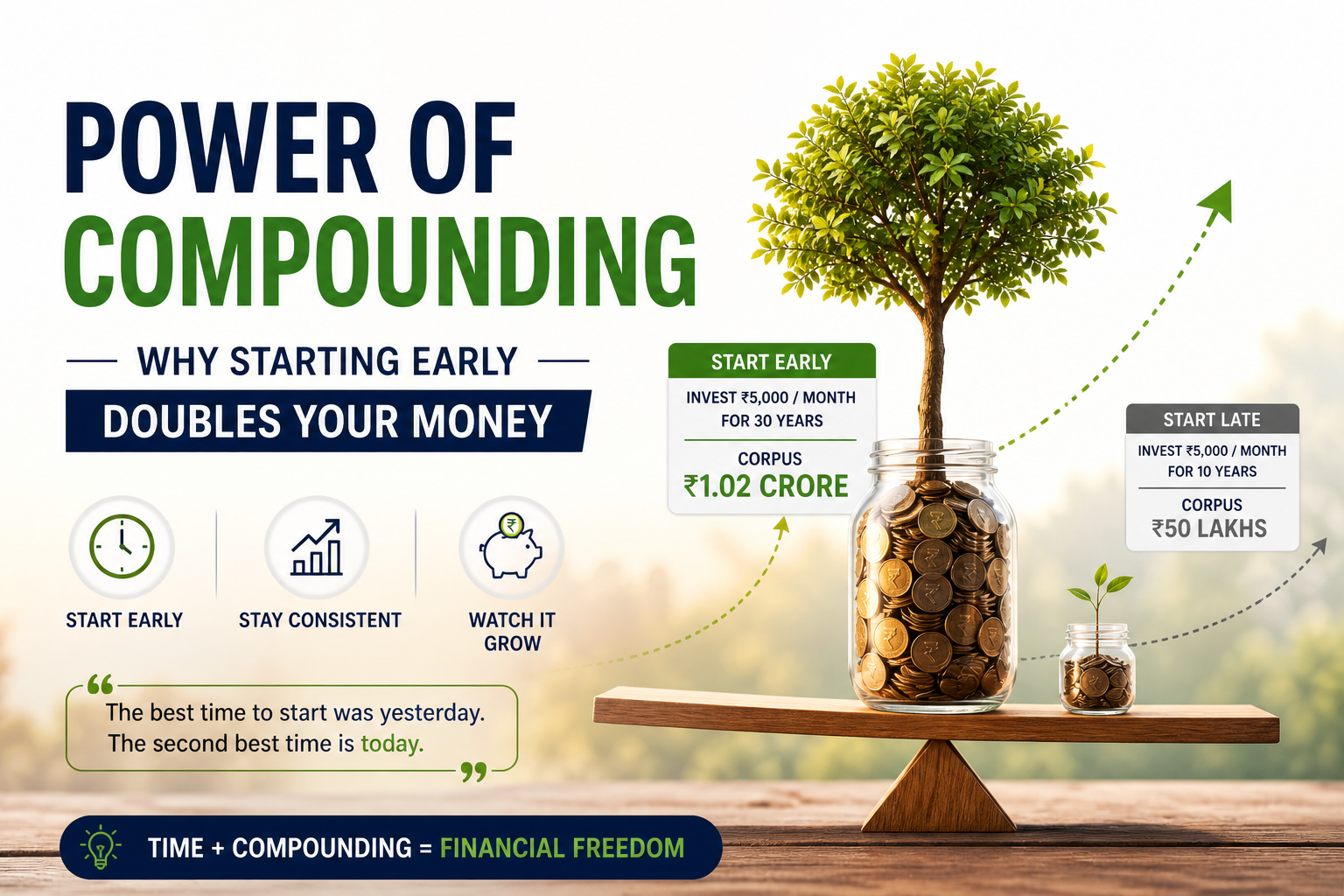
Power of Compounding: Why Starting Early Doubles Your Money
Albert Einstein reportedly called compound interest the "eighth wonder of the world." Whether he said it or not, the math is undeniable — starting your SIP just 5 years earlier can nearly double your final corpus. This is the single most important concept every investor must understand.
- 1. What is Compounding?
- 2. How Compounding Works in SIP
- 3. Early vs Late — The Real Numbers
- 4. The Rule of 72
- 5. The Snowball Effect Explained
- 6. What Destroys Compounding
- 7. How to Maximize Compounding
- 8. Real World Compounding Examples
- 9. Compounding Works Everywhere
- 10. Action Steps to Start Today
- 11. Frequently Asked Questions
1. What is Compounding?
Compounding is the process where your investment generates returns, and those returns then generate their own returns. In other words — your money makes money, and that money makes more money.
Unlike simple interest (where you earn returns only on your principal), compound interest earns returns on both your principal and all previously earned returns. Over time, this creates an exponential growth curve rather than a straight line.
Simple vs Compound: ₹1 lakh at 12% simple interest for 30 years = ₹4.6 lakh. The same ₹1 lakh at 12% compound interest for 30 years = ₹29.96 lakh. That's a 6.5× difference — purely from the compounding effect.
2. How Compounding Works in SIP
In a SIP, compounding works on two levels simultaneously:
Level 1 — Your Monthly Investments Compound
Every ₹5,000 you invest this month starts compounding immediately. Next month's ₹5,000 also starts compounding. Each installment has a different compounding period — your first SIP installment compounds for the entire duration, while your last installment compounds for just one month.
Level 2 — Your Returns Compound on Themselves
In Year 1, you earn returns on ₹60,000 invested. In Year 2, you earn returns on ₹1.27 lakh (invested + Year 1 returns). By Year 10, you're earning returns on ₹11.61 lakh — most of which is compounded growth, not your own money.
Key Insight: In a ₹5,000/month SIP at 12% for 30 years — you invest ₹18 lakh but receive ₹1.76 crore. That means ₹1.58 crore (90% of your final corpus) comes purely from compounding — not from your own money.
3. Early vs Late — The Real Numbers
Nothing illustrates the power of compounding better than comparing what happens when you start at different ages with the same monthly SIP of ₹5,000/month at 12% annual return, investing until age 60:
The Cost of Waiting: Starting at 35 instead of 25 costs you ₹1.18 crore — even though you invested only ₹6 lakh less. Those extra 10 years of compounding are worth more than the money itself.
| Start Age | Years Investing | Total Invested | Final Corpus | Compounding Gain |
|---|---|---|---|---|
| 25 | 35 years | ₹21 L | ₹1.76 Cr | ₹1.55 Cr |
| 30 | 30 years | ₹18 L | ₹1.06 Cr | ₹88 L |
| 35 | 25 years | ₹15 L | ₹58.4 L | ₹43.4 L |
| 40 | 20 years | ₹12 L | ₹30 L | ₹18 L |
4. The Rule of 72
The Rule of 72 is a simple mental shortcut to calculate how long it takes for your money to double at a given return rate:
At 12% annual return: 72 ÷ 12 = 6 years to double your money
This means at 12% returns:
- Year 0: ₹1 lakh
- Year 6: ₹2 lakh
- Year 12: ₹4 lakh
- Year 18: ₹8 lakh
- Year 24: ₹16 lakh
- Year 30: ₹32 lakh
Every 6 years, your wealth doubles. This is why the last few years of a long investment are the most powerful — your corpus is at its largest and growing the fastest.
Quick calculation: At 8% returns, money doubles every 9 years. At 15% returns, money doubles every 4.8 years. Use this rule to quickly estimate the impact of different return rates.
5. The Snowball Effect Explained
Compounding is often described as a snowball rolling downhill. Here's why that analogy is perfect:
- Small start: A small snowball at the top of the hill — just like your first small SIP amount
- Picks up snow (returns): As it rolls, it picks up more snow — just like your returns accumulate
- Grows exponentially: The bigger it gets, the more snow it picks up per rotation — just like your larger corpus generates bigger absolute returns each year
- Speed matters: A longer hill = more time = much bigger snowball at the bottom — just like more years = dramatically larger corpus
The critical insight is that the final section of the hill is where most of the growth happens. The snowball that took 20 years to build will grow more in Year 25 than it did in the entire first 10 years combined.
6. What Destroys Compounding
Just as compounding can multiply your wealth, certain behaviors can destroy it entirely. These are the biggest compounding killers:
- Stopping SIP during market crashes — this is the single biggest mistake. Market dips are when you're buying units at a discount.
- Withdrawing early — taking money out resets your compounding clock. Even a partial withdrawal can cost lakhs over 20 years.
- Switching funds too often — each time you switch, you may trigger exit loads and taxes, and restart compounding from a lower base.
- Waiting for the "right time" — there is no perfect time. Every month you wait is a month of compounding lost forever.
- High expense ratios — a 1.5% expense ratio vs 0.5% can reduce your final corpus by 20–25% over 30 years.
- Not reinvesting dividends — always choose growth option over dividend payout to keep compounding working.
7. How to Maximize Compounding
Start as Early as Possible
Every year you delay reduces your final corpus exponentially. Even ₹500/month started at 22 beats ₹2,000/month started at 32 in many scenarios.
Never Stop — Even During Crashes
Market downturns are compounding opportunities. Units bought cheap during crashes give massive returns when markets recover. Stay the course.
Use Step-Up SIP
Increase your SIP amount by 10% every year. This amplifies compounding further by putting more money to work earlier each year.
Choose Low Expense Ratio Funds
Always prefer direct plans over regular plans. A 1% lower expense ratio saves lakhs over 20–30 years by keeping more money compounding.
Reinvest All Returns — Choose Growth Option
Never choose dividend payout options. Always select the growth option so all returns stay invested and continue compounding.
Stay Invested for the Longest Possible Duration
The last 5 years of a 30-year SIP generate more wealth than the first 15 years combined. The longer you stay, the more exponential the growth.
See Compounding Work in Real Time
Use our free SIP calculator — move the duration slider from 10 to 30 years and watch how compounding explodes your wealth.
8. Real World Compounding Examples
Example 1 — The Late Starter Investing More
Rahul starts SIP at age 35 with ₹10,000/month. Priya starts at age 25 with ₹5,000/month. Both invest until age 60 at 12% returns.
- Rahul (₹10,000/month for 25 years): Final corpus = ₹1.89 Cr, Total invested = ₹30 L
- Priya (₹5,000/month for 35 years): Final corpus = ₹1.76 Cr, Total invested = ₹21 L
Rahul invested ₹9 lakh more than Priya but ended up with only slightly more. Priya's 10 extra years of compounding almost completely offset Rahul's double investment amount.
Example 2 — The Power of the Last 5 Years
Consider a ₹10,000/month SIP at 12% for 30 years. The corpus at year 25 is approximately ₹1.89 crore. The corpus at year 30 is approximately ₹3.53 crore.
The last 5 years alone added ₹1.64 crore — more than the entire first 20 years of investing combined. This is the exponential nature of compounding in action.
Example 3 — Small Amount, Long Time
₹1,000/month started at age 20 at 12% returns, invested for 40 years = ₹1.17 crore from just ₹4.8 lakh invested. A 24× multiplier from compounding alone.
9. Compounding Works Everywhere in the World
Compounding is not an India-specific phenomenon. The mathematics of exponential growth applies equally to every investor globally:
- USA: S&P 500 index has delivered ~10% annual returns over the last 100 years. $100/month for 40 years at 10% = $637,000
- India: Nifty 50 has delivered ~12–14% annual returns over the last 20 years. ₹5,000/month for 30 years at 12% = ₹1.76 crore
- Europe: MSCI Europe Index has delivered ~8–9% over 30 years. €200/month for 30 years at 8% = €298,000
- Global: A globally diversified ETF portfolio has historically returned 7–10% annually over long periods
Our SIP Calculator supports 15 currencies so you can calculate compounding in your own currency — INR, USD, EUR, GBP, AED and more.
10. Action Steps to Start Today
Understanding compounding is valuable. Acting on it is transformative. Here are concrete steps to start harnessing the power of compounding right now:
- Open an investment account today — not tomorrow, not next month. Every day matters. Use INDmoney, Groww, or Zerodha Coin in India.
- Start with whatever you can afford — even ₹500/month is enough. The amount matters far less than starting early and staying consistent.
- Set up a Step-Up SIP — increase your SIP by 10% every year to amplify compounding further.
- Choose a diversified equity fund — for long horizons (10+ years), equity funds have historically provided the best compounding.
- Set a reminder to not touch it — seriously. The biggest compounding mistake is withdrawing early. Automate and ignore.
- Use a calculator to stay motivated — seeing your projected corpus grow over time keeps you committed during market downturns.
11. Frequently Asked Questions
How often does compounding happen in SIP?
In mutual fund SIPs, compounding happens daily (since NAV is calculated daily) but the effective compounding frequency for SIP calculations is monthly, as each installment is invested monthly and grows from that point.
Does compounding work in market downturns?
Yes — in fact, downturns are when compounding is set up for its biggest gains. When you buy units at lower prices during a downturn, those units compound massively when markets recover. Stopping SIP during crashes is the biggest mistake an investor can make.
What is the minimum return needed for compounding to be effective?
Any positive return compounds. Even at 6% (debt fund level), ₹5,000/month for 20 years grows to ₹46 lakh from ₹12 lakh invested. At 12%, it grows to ₹50 lakh. Higher returns amplify compounding dramatically.
Is compounding the same as compound interest?
Yes, essentially. Compound interest is the technical term — compounding is the concept. In mutual funds, it's more accurately called "compound returns" since you're earning market returns (not a fixed interest rate), but the mathematical principle is identical.
Can I see compounding in action on a calculator?
Yes. Use our free SIP calculator — set a 30-year duration and watch how your corpus grows. Then change it to 20 years and see the dramatic difference. That difference is pure compounding.
What destroys compounding the most?
Time loss is the biggest destroyer. Withdrawing money early, stopping SIP during crashes, or simply starting late — all of these rob you of compounding years that can never be recovered.
Disclaimer: This article is for educational and informational purposes only and does not constitute financial, investment, or tax advice. Investment in mutual funds is subject to market risks. Please read all scheme-related documents carefully before investing. Past performance is not indicative of future results. Consult a SEBI-registered investment advisor before making any investment decisions.